
Silentina
Get the font


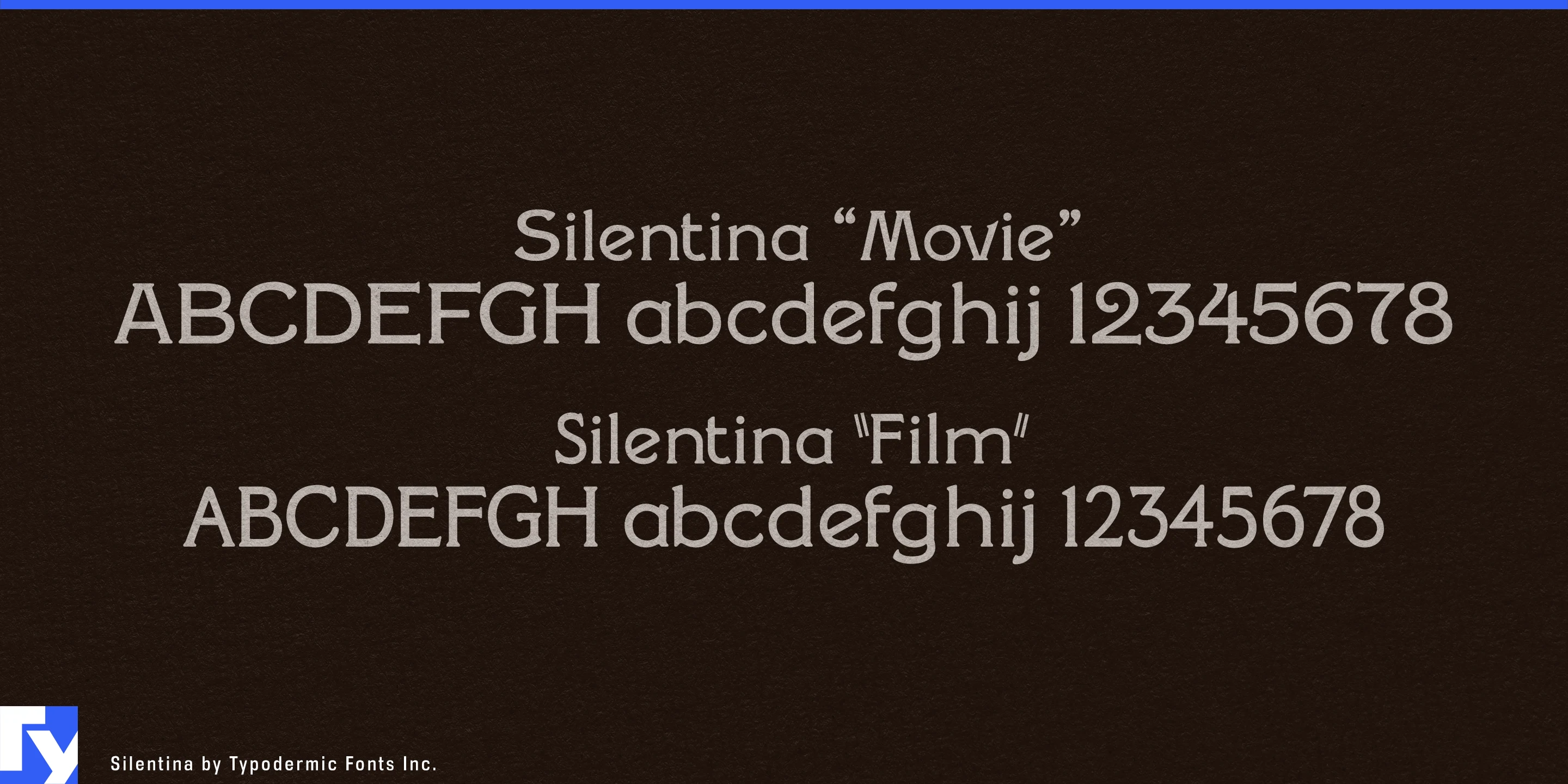


When newly made lettering appears beside silent-film footage, the wrong typeface can expose the reconstruction immediately. A generic vintage serif feels vague; an Art Deco display face often arrives a decade too late, and film grain cannot disguise modern letterforms. Silentina draws on the typography of silent-film intertitles, providing a convincing foundation for dialogue cards, narrative captions, opening titles and reconstructed footage.
Silentina Movie is based on Pastel, a rounded serif frequently seen in 1920s intertitles. Silentina Film combines Pastel lowercase with capitals derived from Della Robbia. This pairing reflects the period practice of assembling capitals and lowercase from different faces; the stylistic shift between cases becomes part of the historical character.
The two fonts can divide the work within a single production. Silentina Movie establishes a consistent voice for dialogue and narration, while Silentina Film introduces more formal, inscriptional capitals. They can distinguish opening credits, chapter headings, spoken dialogue, location cards and closing titles, or serve independently when matching surviving source material.
Rounded, low-contrast forms remain comfortable in centered, multiline compositions. Softened edges suggest lettering that has passed through photography, duplication and projection, helping fresh text settle naturally into film grain and restored footage. Instead of distressing an unrelated modern serif, designers can begin with period structure and an appropriately reproduced finish.
Silentina can replace missing or damaged cards, recreate translated intertitles and add explanatory text to restored films without disrupting their visual continuity. It also suits contemporary silent films, flashbacks, dream passages, theatrical prologues and mock archival sequences.
Beyond the screen, Silentina can connect retrospective posters, screening programs, restoration credits, lobby displays and menus for disc or streaming collections. Documentaries about early cinema, vaudeville and historic theatres can use it for chapter cards, quotations and transitions into archival material. Narrative games, escape rooms and museum installations can apply the same language to lost-film mysteries, recovered footage, clue cards and abandoned picture palaces.
Silentina gives new typography a credible place in the visual world of silent film. Its Pastel foundation, alternate capital treatment and gently reproduced texture supply the working parts needed to build that world rather than merely decorate it.
Get Silentina
Desktop licenses cover print, logos, and static graphics. MyFonts also offers embedding licenses for websites, e-books, and applications. Embedding licenses
Commercial font facts
Family details
- First released
- 2004
- Styles
- 2 styles
- Version
- 2.101
- Formats
- OTF
- Class
- Serif
- Form
- Rounded, Low contrast
- Case
- Mixed case
- Scripts
- Latin
- Role
- Display
Commercial style names (2)
- Film
- Movie